Welcome to the Grooved whale project
As a composer and whale researcher, I study the "hierarchical masterpiece" that is humpback whale song. Humpback whales provide a compelling analogue for extraterrestrial intelligence because they exhibit complex cognition that has evolved within a sensory world fundamentally different from our own. Their songs are hierarchically structured, culturally transmitted, and composed of non-random acoustic patterns that closely resemble the kinds of signals targeted by SETI research. As such, humpback whale song offers a valuable model system for developing and testing intelligence filters in the search for extraterrestrial life.
Beyond its structural complexity, humpback whale song is a culturally driven communication system that functions as a mediator of social organization and collective behavior. It therefore provides an important opportunity to investigate the mechanisms that act as the "glue" enabling the emergence, maintenance, and evolution of complex societies. By studying how information, culture, and communication interact in humpback whales, we may gain insights not only into the nature of non-human intelligence on Earth but also into how intelligence might manifest elsewhere in the universe.
This work bears directly on the longevity term (L) in the Drake Equation by examining how culturally transmitted communication systems contribute to social cohesion, resilience, and the long-term persistence of intelligent populations. By treating humpback whales as a “terrestrial analogue,” my work opens new pathways for the design of a universal communication protocol, the syntax of which supports proto-first-contact scenarios and informs the architecture of interstellar messages (METI).
.JPG/:/rs=w:400,h:400,cg:true,m/cr=w:400,h:400)
from INTERSPECES TO interstellar
Alien Analogue
New Detection Frameworks
New Detection Frameworks

Humpback whales provide a powerful model for understanding the relationship between communication complexity and social complexity. Their songs exhibit a clear hierarchical structure, in which simple units (notes) combine into phrases, phrases into themes, and themes into complete songs. This rule-based organization is not arbitrary but can be measured mathematically, following statistical patterns such as Zipf’s Law.
Their songs are culturally transmitted rather than genetically fixed, and populations can rapidly shift to entirely new songs in events known as “song revolutions.” Song structure is also shaped by social and reproductive dynamics, particularly in mating systems where males compete for access to females. In this context, song functions as a display signal that helps mediate male–male competition and supports broader social organization.
Together, these features demonstrate that humpback whale song is both highly structured and socially driven, making it an important system for studying the evolution of complex communication.
New Detection Frameworks
New Detection Frameworks
New Detection Frameworks
Current methods of whale song analysis often isolate individual components without integrating them into a cohesive system that captures the song’s full complexity. By applying a music-based framework, I identify the underlying rules and logic that shape its evolving structures, offering insight into the cognitive capacities of the mind composing the song.
My work focuses on rhythm. As biologist Roger Payne observed, there are striking parallels between human and whale rhythmic organization; I build on this idea by proposing that both species are shaped by a shared temporal architecture—a deeply encoded foundation that can support the development of a universal communication protocol through a shared syntax.
Ultimately, this approach contributes to the development of intelligence filters: logics of organization that transform speculative variables in the Drake Equation, such as intelligence and communicative detectability, into measurable biological markers.
from music to meti
Hybrid Forms
Hybrid Forms
Hybrid Forms
My creative–analytical practice focuses on developing models for hybrid musical works that blend the architectures of whale and human song across a continuum of “human-ness” and “humpback-ness.” These models interact dynamically, generating a wide range of expressive outcomes depending on the input and system parameters.
By feeding in recordings I have collected over the years, the system learns patterns of song evolution, with the long-term goal of applying mathematical logic to generate prototypes of future song forms and map possible evolutionary trajectories. This approach opens the possibility of anticipating how songs may develop over time, suggesting what a population’s song might sound like in the future.
Ultimately, this work aims to model the internal logic of the whale as a continual composer, offering a framework for exploring the creative processes of a non-human species from within its own structural and perceptual system.
Interactive
Hybrid Forms
Hybrid Forms
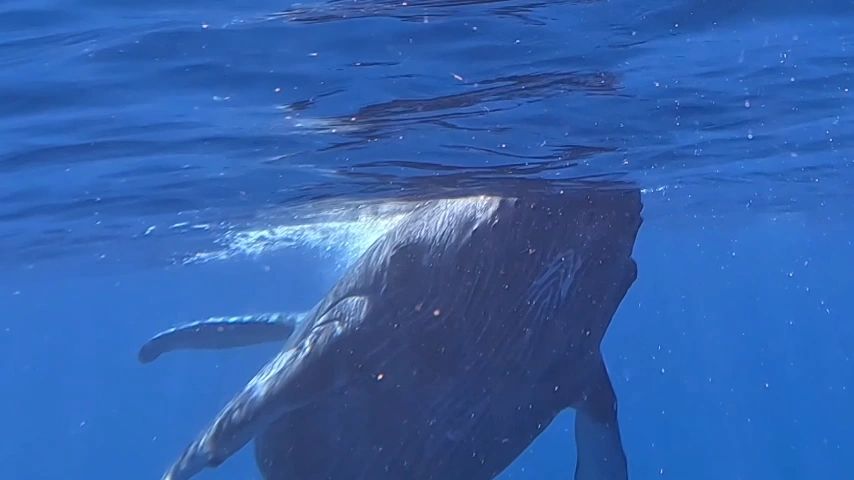
One experience in particular came to shape my work. While my investigative practice sought to better understand the internal logic of whale song, my creative approach unfolded through a direct, interactive encounter with a humpback whale. Using my violin as a mediating instrument. I engaged in a real-time exchange that moved beyond simply playing for the whale; instead, I listened closely to its vocal patterns and responded through a range of approaches, from careful mimicry to more interpretive adaptations.
This encounter operated as an experimental dialogue, offering a tangible context in which I could test how structural rules might support cross-species communication, while exploring ideas for prototyping first contact with a non-human alien intelligence.
Song of the curious Alien: 2024 Astrobiology conference
Held from May 5–10, 2024, in Providence, Rhode Island, AbSciCon is the premier U.S. conference for researchers exploring the origin, evolution, distribution, and future of life in the universe. My presentation at this gathering contributed to a robust exchange of ideas among the over 1000 attendees including planetary scientists, biologists, chemists, physicists, SETI researchers, and interdisciplinary thinkers working at the frontiers of life detection and communication.
I was part of the “Explore the intersection of Artificial Intelligence (AI) and novel biosignatures discovery” session which showcased how AI-driven algorithms and machine learning techniques are revolutionizing our approach to understanding and predicting potential signs of life beyond Earth and how AI can be used to quantify intricate features, discern patterns, and identify biological and emergent processes amidst background environmental interactions. The session was convened by Dr. Jian Gong (University of Wyoming) as Primary Convener, with additional conveners Dr. Kimberly Warren-Rhodes (SETI Institute, Mountain View), Dr. Michael Phillips (Lunar and Planetary Laboratory, University of Arizona), and Dr. Atılım Güneş Baydin (University of Oxford).

Interspecies communication: conversing with Humpback Whale T
In a landmark interactive playback experiment designed to explore the structure and dynamics of humpback whale communication, the Whale SETI team sustained a vocal exchange with a free‑swimming humpback whale. As a participant in the exchange, I contributed field expertise and analytical insight, helping document, interpret, and contextualize the whale’s vocal response patterns within broader cross‑species communication research.
McCowan B, Hubbard J, Walker L, Sharpe F, Frediani J, Doyle L. 2023. Interactive bioacoustic playback as a tool for detecting and exploring nonhuman intelligence: “conversing” with an Alaskan humpback whale. PeerJ 11:e16349 https://doi.org/10.7717/peerj.16349
composing hybrid music

Beyond Human is a collection of songs composed as a form of inquiry, an exploration of the underlying principles that shape the biological organization of "song". What you hear are experiments where whale models of sound organization meets the human model and the algorithmic compositional process plays with the boundaries and borderlines . In this approach, music becomes a way to probe the inner sanctum of song itself.
You may find them repetitive, cheesy, boring, normal, interesting, and that's the fun of the process, letting the model learn the logics and dictate the outcome.
Two of the humpback songs used for training the models are in the videos below.
Please visit Spotify to hear the full tracks