Preparing for First contact
Cetacean intelligence as a model for Universal Communication Code
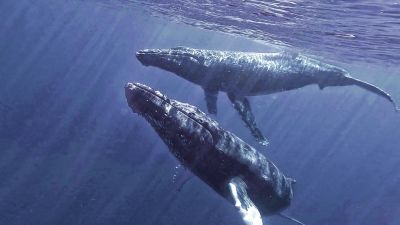
Describing Humpback song as a “masterpiece of hierarchies,” I focuses on uncovering the nee rules and logic that shape its syntax. Drawing on deep evolutionary blueprints, she explores how its structure might inform the design of a species -agnostic communication protocol. Scientific and intuitive approach Approaching her interactions with humpbacks as a form of proto–first contact, she offers insight into how we might prepare for the possibility of discovering - or being discovered by - life beyond Earth.
This project proposes that human interaction with cetacean intelligence (whales and dolphins) provides an existing, empirically grounded model for SETI. I investigate how intelligence can present itself through patterns. The more we can self identify with the animals we study the greater the wealth of information we can plumb from ourselves. A self test of intelligence. This is how we best prepare ourselves. Open the dialogue by examining our own musicality, the experience the corporeality of it all.
By treating whale communication as a form of “Earth-based SETI,” this project contributes new frameworks for interpreting ambiguous signals, avoiding anthropocentric bias, and preparing for the complexities of extraterrestrial discovery.
his project proposes that humanity already has an empirical model for this process: our ongoing interaction with cetacean intelligence.
I approach cetacean intelligence as a form of “Earth-based SETI.” Cetaceans exhibit complex cognition and communication, including structured acoustic signals and socially meaningful vocalizations such as individually distinctive “signature whistles” that function as identifiers within social networks. distinguishing meaningful patterns from noise and deciding what counts as evidence. The overlap in our systems of song is where I am most at home and have the most to offer. Why would two diverse species, Roger Payne noted, have such similaraties? He theorized universal music might come from a universal physics. . How do we leverage this overlap?ur frame
👽 Designing a proto-syntax for alien contact (conceptual)
If you were to intentionally construct something from this:
Step 1: Establish signal vs noise
- Repetition at consistent intervals
- Clear periodic structure
Step 2: Introduce variation
- Slight changes to show intentionality
- Escalate complexity gradually
Step 3: Use ratios and scaling
- Frequencies with simple mathematical relationships
- Time intervals with proportional spacing
Step 4: Create call-and-response space
- Send pattern → leave silence
- Observe for mirrored transformation
Step 5: Build “grammar of transformation”
Instead of fixed meanings:
- A → A'
- A → reversed A
- A → stretched A
👉 Meaning emerges from relationships, not symbols.
Describing Humpback song as a “masterpiece of hierarchies,” I focuses on uncovering the need sets of rules and logic that shape its syntax. Drawing on deep evolutionary blueprints, she explores how its structure might inform the design of a species -agnostic communication protocol. Scientific and intuitive approach Approaching her interactions with humpbacks as a form of proto–first contact, she offers insight into how we might prepare for the possibility of discovering - or being discovered by - life beyond Earth.
My framework for the search for life beyond Earth is not only a technological challenge of detection, but a profoundly human challenge of interpretation. discovery unfolds over time, shaped by uncertainty, communication, and evolving understanding rather than a single definitive moment
Its practice time, its proof of concept time. the patterns come from an understanding of ourselves, its something ai can't give us. The experience of being human and having music.
Here is potential for great dialogue across disciplines on the potential effectiveness of music based system for modeling first contact.
In parallel, this research explores the role of communication in shaping understanding. As a naturalist and communicator, I translate non-human behavior into human narratives, operating at the interface between science and public perception. This aligns with the Lab’s focus on how discoveries are communicated and how societies interpret and respond to them. These interactions provide insight into how meaning is constructed, contested, and shared under conditions of uncertainty. [projectceti.org]
Ultimately, this work reframes human–animal interaction as more than analogy: it is proto–first contact already in progress. By integrating field experience, interdisciplinary analysis, and public communication, this project provides a grounded framework for recognizing intelligence, designing communication strategies, and preparing for the complex realities of discovering life beyond Earth.
Ultimately, my work reframes human–animal interaction as more than analogy—it is, in many ways, proto–first contact already in progress. Through sustained interaction with non-human intelligences on Earth, we are already confronting the challenges of recognizing intelligence outside our own frameworks, constructing shared meaning, and navigating the limits of communication. I believe these lived, empirical experiences can offer valuable insight into how humanity may respond to the discovery of life beyond Earth—or to the equally profound possibility of being discovered.
I come to this space through my background as a naturalist, communicator, and researcher working at the intersection of human–animal interaction and what I think of as “Earth-based SETI.” My work focuses on cetacean intelligence—particularly orcas and humpback whales—and includes collaborations connected to leading-edge efforts in decoding whale communication, including work alongside researchers such as Fred Sharpe. In the field, I have been directly engaged in interpreting non-human communication systems that are complex, meaningful, and only partially understood.
We tend to picture first contact as a dramatic message, but the truth is we are already preparing for it through SETI, METI, the Drake Equation, and even experiments in whale communication—because the real challenge is not receiving a message but recognizing intelligence at all; the Drake Equation itself is less a calculation than a framework forcing us to think about how communicative civilizations arise and persist, while CETI research shows that building a shared language with non-human minds requires abandoning human assumptions and starting from universal structures like mathematics and signal patterns; this is why studying non-human intelligences like humpback whales—where researchers observed structured back-and-forth responses to greeting signals—matters, as it helps develop “intelligence filters” to detect intentional communication beyond human form; in practice, the first signal we detect will likely appear not as meaning but as non-random structure—something that stands out from cosmic noise—forcing us into a “handshake” phase where both sides must recognize that communication is even happening before meaning can emerge, a process requiring mutual recognition and response; in that sense, all of this work is less about aliens and more about us—testing not just how we might communicate, but how humanity will interpret, react, and decide who speaks for Earth—so that when first contact comes, it won’t begin with understanding, but with a subtle, transformative realization: that what we are observing is not just a signal, but another intelligence reaching back.